


Framework overview and intent
We present a structured framework for bus fleet management that ties capabilities to measurable outcomes and operational stages. A practical fleet management solution must connect raw telemetry to decisions; this framework shows how to do that reliably. London’s Ultra Low Emission Zone (ULEZ) is an example of regulation that forces fleet operators to combine emissions monitoring, route planning and duty-cycle data into a single operational picture. This section uses the term commercial vehicle fleet management when discussing those converged requirements.

Core capability layers
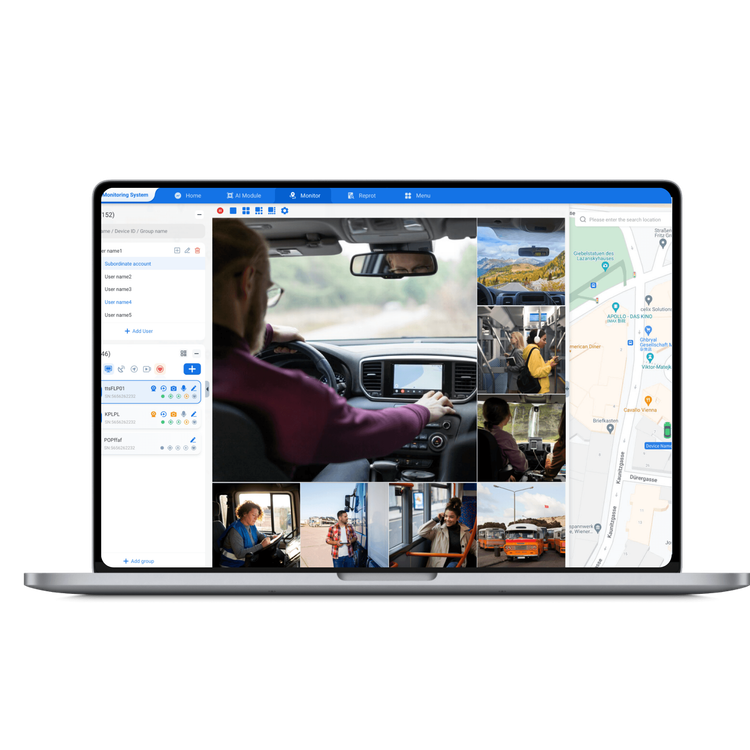
Effective systems separate capabilities into clear layers so teams can assign responsibilities and measure performance. The layers we use are:- Data acquisition: GPS, CAN-bus reads, fuel flow sensors, temperature and door-state inputs.- Edge processing: local filters, event detection, short-term storage to avoid data gaps.- Telemetry transport: secure, loss-tolerant channels with message priority for alarms.- Cloud analytics: time-series storage, rule engines, predictive models, compliance reports.- Operator interfaces: dispatch consoles, driver apps, scheduled reports, API endpoints for ERP or maintenance systems.- Governance: data retention, access control, and audit trails that satisfy auditors and insurers.
Operational metrics to track
Quantify the business case with metrics that map directly to cost and service quality.- Vehicle utilization rate (hours in service per available hour).- Mean time between failures (MTBF) and mean time to repair (MTTR).- Fuel consumption per scheduled kilometer and per route.- On-time performance and dwell-time variance at stops.- Emissions exposure per route segment where compliance matters.These metrics drive procurement, maintenance cycles and route redesigns.
Deployment stages and responsibilities
Adopt a stage-based rollout to reduce risk and accelerate value capture.- Assess: inventory vehicles, existing telematics, wiring and data sources.- Pilot: equip a representative subset of vehicles and run for one service cycle.- Integrate: map outputs to depot maintenance systems and dispatch workflows.- Scale: roll out in waves, validating operations and adjusting thresholds.- Operate: assign data steward, maintenance liaison and analyst roles.Common governance responsibilities: the fleet manager owns utilization targets; engineering owns telemetry fidelity; safety owns alerts and driver coaching protocols.
Use cases and direct benefits
Map use cases to concrete, verifiable benefits rather than soft claims.- Preventive maintenance: replace calendar schedules with condition-based interventions, reducing roadside failures and spare-part spend.- Route optimization: shorten deadhead and adjust timetables to reduce fuel burn and improve punctuality.- Regulatory compliance: produce certified reports for zones like ULEZ without manual reconciliation.- Safety and training: use event data for targeted coaching, lowering incident rates.Each outcome should have a linked KPI; a trial must commit to baseline measurement and a hypothesis for improvement.
Alternatives and trade-offs
Evaluate three pragmatic approaches and their trade-offs.- Turnkey vendor: faster deployment, less control over data schema, vendor SLAs.- Open-source stack: full control and lower licensing cost, higher integration and maintenance effort.- Hybrid model: core telemetry managed by vendor, analytics and UI built in-house to retain IP.Decide on total cost of ownership across five years, factoring in integration, staffing and compliance costs.
Common pitfalls and how to avoid them
Failures usually come from execution errors, not technology gaps.- Incomplete sensor coverage: install sensors that capture the failure modes you intend to prevent.- Weak data governance: define owners, retention and access up front.- Ignoring driver input: pilots should include driver feedback loops to avoid rejection.- Over-automating alerts: tune thresholds to reduce alarm fatigue before scaling.A short pilot with explicit acceptance criteria prevents costly rework.
Implementation checklist for decision-makers
Use this checklist to convert intent into an actionable plan.- Define top three KPIs and baseline them.- Select representative pilot fleet and period.- Specify data sources and minimum telemetry fidelity.- Choose integration endpoints for maintenance and payroll systems.- Assign roles: data steward, operations integrator, vendor liaison.- Run post-pilot validation against KPIs and adjust procurement accordingly.
Conclusion
The framework presented aligns technical layers, operational stages and business metrics so decisions are traceable and defensible. Our experience working with municipal and private operators shows that disciplined pilots, clear governance and metric-driven scaling yield steady reductions in downtime and compliance overhead. The resulting capability set becomes an operational asset when combined with vendor technology that supports robust telemetry, secure transport and actionable analytics, a role exemplified in practice by BSJ.

