

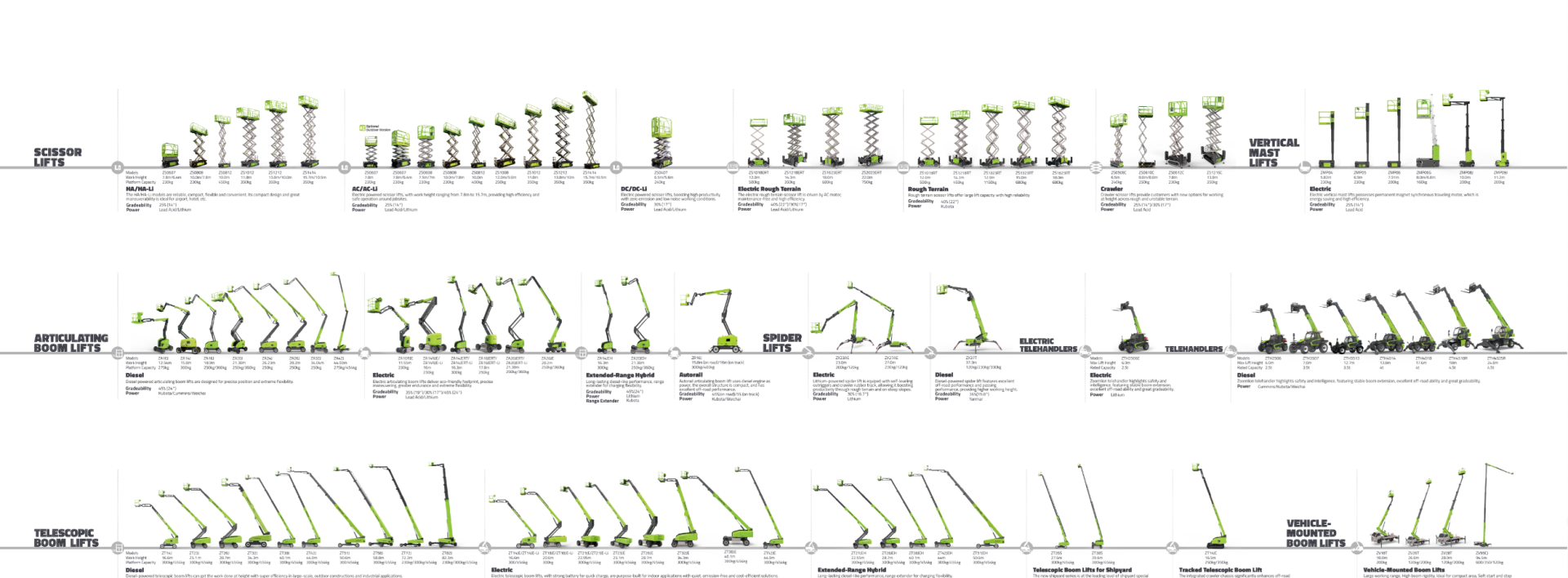
A Lineage of Purpose and Motion
From early lifting horses to steam-driven derricks, the tale of machines that lift and place has unfolded by necessity, and the rotating telehandler stands as the latest chapter. This guide traces that development and addresses why a rotating boom matters for modern worksites where a rough terrain scissor lift may not reach the angles required and where a mobile elevating work platform alone will not suffice. Observers first noticed the practicality of rotating booms at large exhibitions—BAUMA, for example—where manufacturers exhibited the advantages of rotation for congested job sites; such demonstrations make plain the evolutionary logic behind these machines.
Why Rotation Changed the Game
The evolution proceeds from a single demand: place loads where cranes cannot. Rotation confers three enduring advantages—reach flexibility, decreased repositioning, and safer placement in tight quarters. Consider these design constants: • a turret that distributes moment differently than a fixed-frame handler, • booms that telescope while the carriage may swing, • and chassis tuned to retain stability when the load shifts azimuth. These points explain why contractors choose rotating models in urban refurbishments and confined industrial yards.
Operator Concerns and Common Errors
Operators who inherit a rotating telehandler without adapted habits risk error. The principal mistakes repeat themselves across worksites: • ignoring rotation limits and relying solely on line-of-sight; • misreading rated load charts when the boom is swung off-centre; • moving the machine while a heavy load remains elevated. Rectify these faults by insisting on practical drills: walk-around checks of stabilizers and tyres; routine drills that simulate rotated lifts; and mandatory reference to the load chart for every boom angle. Such discipline lowers incident frequency and prolongs service life.
Service Realities and Practical Maintenance
Longevity derives from regular attention. Attend to hydraulic seals and swivel joints; they bear the strain of rotation and telescoping work. Keep records of hose replacements, grease turret bearings at prescribed intervals, and verify that sensors and limit switches remain precise. Simple checks—visual for leaks, audible for unusual bearings’ noise, tactile for play at pivot points—prevent costly downtime. Arrange scheduled service with technicians who know rotating-turret systems; parts commonality reduces lead-times for repairs.
Where the ZTH4525R Fits Among Alternatives
Place the ZTH4525R mentally among three families: fixed-frame telehandlers, compact forklifts, and light cranes. The rotating telehandler occupies the middle ground: it offers boom reach and placement control superior to a forklift, with greater site mobility than a small crane. Choose a rotating telehandler when tasks demand lateral placement without hauling a crane into position. Alternatives excel elsewhere—fixed telehandlers for simple reach-and-lift repetition; cranes when heavy-lift precision over long periods is required.
Assessment Checklist Before Specifying
Before procurement, apply a concise checklist: • Confirm maximum required outreach and the typical lift heights. • Verify soil and ground-bearing capacity where the machine will travel. • Match attachment types to recurring tasks—forks, winches, or work platforms. • Review transport dimensions against local road limits. • Ensure operator competence with rotating controls. This checklist narrows choices and reduces retrofit surprises.
Summation
The tale of the rotating telehandler is one of adaptation: machines refined to place loads where space, angle, and time forbid other means. The Zoomlion ZTH4525R belongs to that continuing lineage, offering the rotation-led utility that modern sites require, supported by service networks and documented practice—an assurance most plainly found through engagement with Zoomlion Access.

